

1. The Core Mechanism: Chain Extension via End-Group Reaction
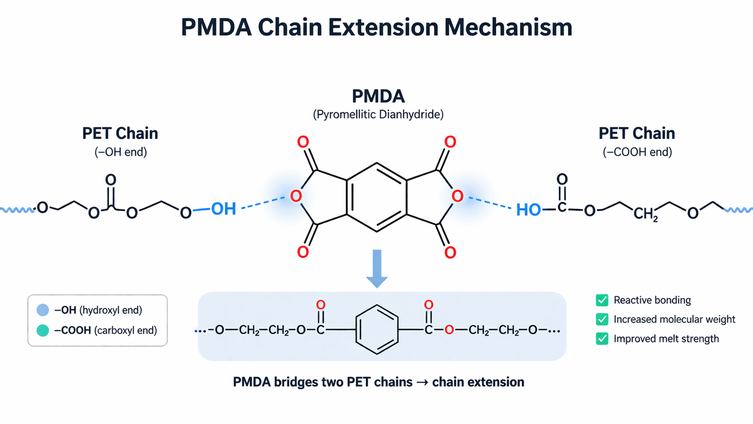
The mechanism of PMDA is fundamentally a reactive chain extension process. PMDA is a molecule with two anhydride functional groups. These groups are highly reactive toward the hydroxyl (-OH) and carboxyl (-COOH) end groups found on PET polymer chains.
The reaction steps are:
- Reaction: During melt processing (typically via extrusion), the anhydride rings of PMDA open and react rapidly with the -OH and -COOH ends of degraded or shorter PET chains.
- Rebuilding: A single PMDA molecule can react with two different PET chains, effectively linking them together.
- Result: This coupling action increases the average molecular weight, restores intrinsic viscosity (IV), and significantly improves melt strength.
This mechanism directly counters the thermal and hydrolytic degradation that occurs during PET recycling or multiple processing steps.
2. Mechanism in R-PET Recycling: Restoring Value
In R-PET recycling, polymer chains are inevitably shortened, leading to low IV, brittleness, and poor processability.
- Action: PMDA reacts with the end groups of these fragmented chains, reconnecting them into longer, more entangled structures.
- Benefit: The restored molecular weight brings back mechanical properties (tensile strength, impact resistance) and melt elasticity, making R-PET suitable for sheet extrusion, strapping, and engineering plastics.
- Commercial Advantage: This offers a cost-effective alternative to epoxy chain extenders, especially for industrial-grade applications where food-contact compliance is not required.
For more information, please refer to: https://www.zbaqchem.com/pyromellitic-dihanhydride/pyromellitic-dianhydride-chain-extender.html
3. Mechanism in PET Color Masterbatch: Enhancing Dispersion & Stability
In PET masterbatch, the mechanism of PMDA provides a secondary, yet valuable, benefit beyond chain extension.
- Increased Melt Viscosity: The chain extension reaction increases the viscosity of the PET carrier resin.
- Improved Shear Transfer: Higher viscosity generates and transfers stronger shear forces to pigment agglomerates (e.g., TiO₂, carbon black, organic pigments).
- Resulting Dispersion: This enhanced shear breaks down agglomerates into primary particles, achieving more uniform pigment dispersion. The outcome is fewer color specks, higher tint strength, and batch-to-batch color consistency.
By acting as both a chain extender and a dispersion aid, PMDA improves the overall quality and process stability of PET masterbatches.
4. Why This Mechanism Matters: PMDA vs. Epoxy Chain Extenders
The reaction mechanism of PMDA is not only effective but also commercially distinct. Compared to epoxy-based chain extenders:
| Feature | PMDA Mechanism | Epoxy Chain Extender |
|---|---|---|
| Cost | Lower | Higher |
| Reactivity | High (rapid reaction) | Moderate (controlled reaction) |
| Process Stability | Good, requires moisture control | Higher |
| Typical Application | Industrial R-PET, masterbatch, strapping | High-end, food-contact packaging |
For many manufacturers, the PMDA mechanism offers the optimal balance of performance and price, making it the preferred choice for cost-sensitive, high-volume recycling and masterbatch production.
Conclusion
The mechanism of pyromellitic dianhydride (PMDA) in PET applications is a powerful, reactive chain extension process. It directly addresses the challenge of degraded polymer chains in R-PET recycling and indirectly enhances pigment dispersion in PET color masterbatch. By choosing PMDA, processors can achieve higher molecular weight, better melt strength, and improved final product quality at a competitive cost.
Ready to improve your R-PET or masterbatch performance?
Contact JAMMARK INTERNATIONAL TRADINGE, a reliable manufacturer of high-purity PMDA, for:
- Stable quality and supply
- Competitive factory-direct pricing
- Technical support for your application


